International Traceback
Mission

This working group focuses on mechanisms to “trace back” calls or messages to their true origin — that is, determine where a call or message actually originated. The aim is to enable operators and regulators worldwide to reliably attribute unwanted or fraudulent traffic to its source — a foundational step for discouraging abuse, enforcing accountability, and deterring future fraudulent communications.g the true origin of a call
Leadership

Angelas Dais
AT&T

Tim French
Wavecrest
Featured Documents
- White Paper – International Traceback High Level Outline
This document is aimed to be a guide for implementing and operating traceback solutions across the telecoms industry, including but not limited to, network operators, regulators, enforcement organisations, and consumer representative groups
Traceback - why do we need it to fight spams / scams?
Why do we even need traceback?
- Locate the origin of targeted call, i.e. unwanted / fraudulent / illegal call – definitions are jurisdiction and other criteria dependent
- It is complicated to identify the true origin of a call
- the origin number cannot be trusted : can be spoofed : manipulated/altered
- not all spoofing is illegal : multiple legitimate business and technical use cases
- spoofing is easy to use to support fraud
- Retracing call path hop-by-hop is the only way – often manually
- cooperation between operators and between countries is required
- adequate legal & regulatory framework (information sharing, legitimacy of requests…)
- industry cooperation, central, neutral mechanism
A tool for the organizations responsible for fighting unwanted/ fraudulent calls
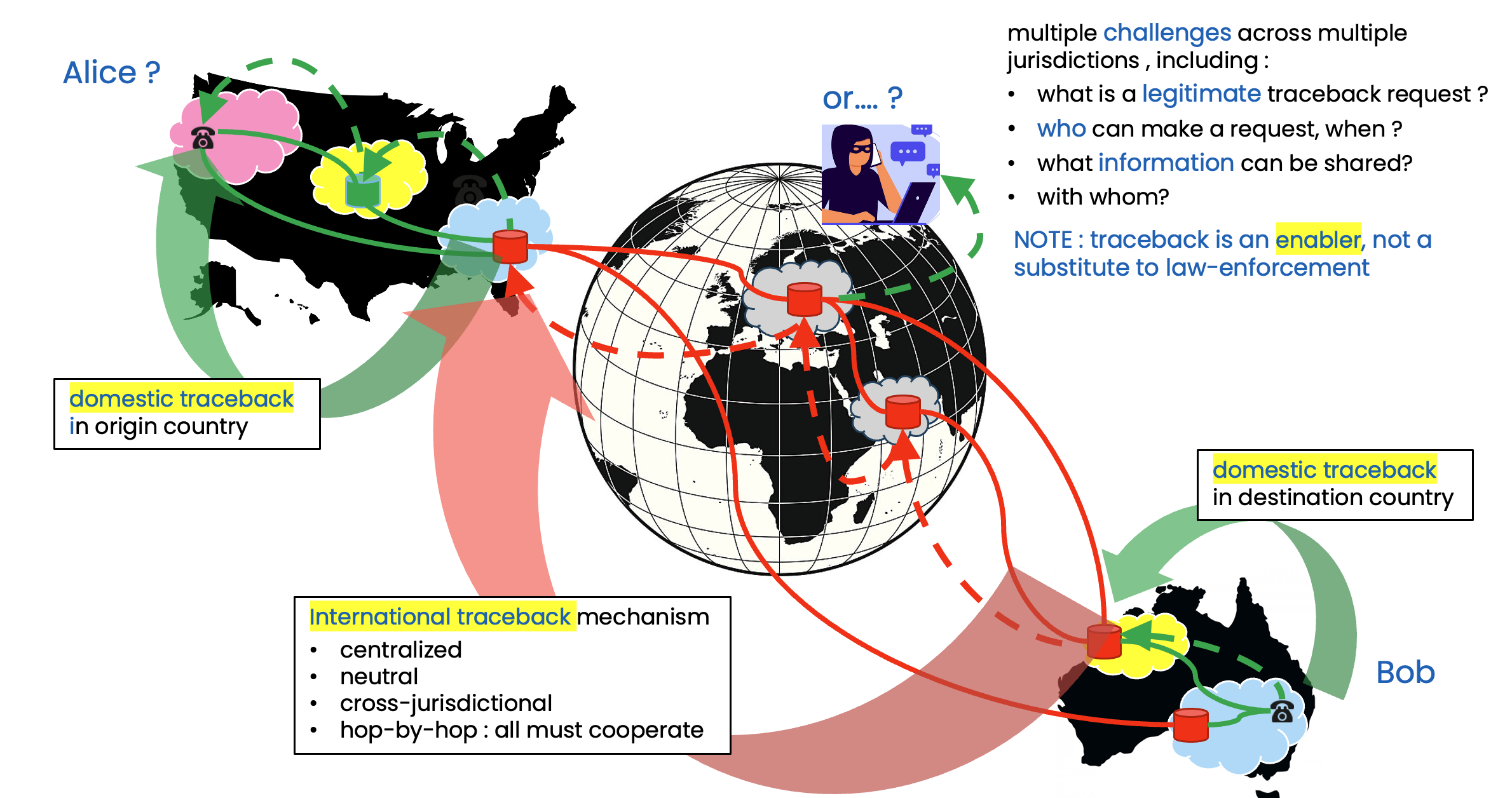
International traceback : locating the origin across multiple countries
- Each country is :
- a destination : bad traffic can be received – and traceback requested
- an origin : bad traffic can be originated
- a transit point for international traffic – a hop in the traceback mechanism
- Domestic traceback in a given country : same jurisdiction, regulator, rules, process…
- Global traceback for international traffic : across multiple jurisdictions
- “Three segment” traceback model:
- initial domestic segment in destination country : single jurisdiction, initiates request
- middle segment covering international transit call path : multiple jurisdictions
- final domestic segment in origin country : single jurisdiction, has origin’s information
- One Consortium focuses on international segment, interfaces with domestic segments, and support to domestic jurisdictions – and discusses the regulatory framework with GIRAF
- Status to date : high level outline available, initiated joint discussion with GIRAF
Who’s really calling Bob?